

01
Cavity Mapping & Grid Drawings
Every compartment drawn to scale against its product, with the clearance stated and the divider position between neighbouring pockets fixed.
Discuss This ServiceMulti Compartment Box Manufacturer in the UAE
Nivada Box is a multi compartment box manufacturer in the UAE specialising in divided rigid boxes, cut board divider grids, cavity maps drawn around your products and multi-pocket packaging for sample kits, tea sets and subscription programmes.

Layout Before Structure
Two products in one box only work if neither can move, lean or leak into the other. That is a layout problem, and it gets settled on a cavity drawing long before anyone opens a conversation about board or finish. The same rule applies wherever multi compartment boxes in the UAE hold a tea set, an assortment box or a monthly subscription.
The number that decides whether a divided box works is the clearance in each pocket. Cut to the nominal size of the product and the item will not go in on a humid afternoon, because board and plastic both grow. Cut loose and the contents rearrange themselves in transit. Most divided boxes go wrong inside that gap, which is why we draw the cavity map against the real measurement of the item rather than the measurement it is listed under.
The second number is the divider. Every wall between two cavities takes usable width away from both of them, and that same wall is carrying whatever sits on top of it. Which is why the rigid outer is not a finish decision. A folding carton gives the grid nothing to brace against, so the walls lean, the pocket tops bow and a six-cavity tray arrives as a tray of loose items.

Layout Styles
A divided box is defined by the arrangement of its cavities, not by the occasion it is bought for. These are the grid patterns we tool most often, each quoted on divider board consumed, cuts per unit and edges to finish.

One wall down the middle, sized so each pocket is cut to a single product rather than being asked to hold two that were never measured together.
View Product
The most common pattern, where every pocket is held to the same tolerance so the grid reads as one deliberate tray rather than a set of boxes in a box.
View Product
Small-format sampling where eleven walls have to be cut square and true, because one leaning divider is enough to make the whole grid look cheap.
View Product
A slot for every piece, with walls tall enough that a bracelet cannot climb over, and a lid that repeats the arrangement as its own pocket.
View Product
Sealed pockets and food-contact-safe facings where one blend must not reach another, and where a sachet leaking would ruin everything beside it.
View Product
Low cavities for flat printed matter, spaced so a leaflet lies flat instead of curling against a divider for the life of the box.
View Product
A wrapped outer with thin board dividers faced in matching material, so the grid looks finished the moment the lid comes off rather than raw.
View Product
Cavities routed into MDF or solid timber, where the walls are part of the material and there is no divider to loosen over years of use.
View Product
One column of pockets for bottles and tall products, deep enough that each item stands clear of the one below it and the box still shuts flat.
View Product
The lid carries its own grid, which doubles the cavity count for a box that looks unchanged from the outside and holds twice as much once open.
View Product
Counter-ready layouts where a tester, an instruction card and a pad each have a home, so a single pocket can be refilled without emptying the tray.
View Product
Heavier dividers, a base pad and stiffened corners, specified for a filled box that will be stacked on a pallet and handled by one person.
View ProductThe Grid Is Structural
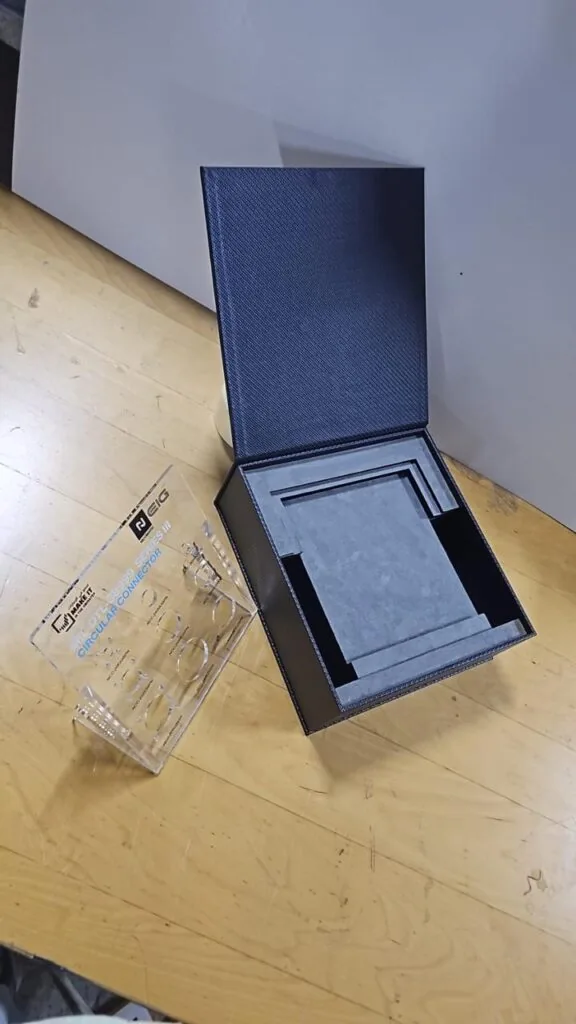
Once a box is divided, the dividers stop being packaging and start being structure. Every pocket wall is doing two jobs at once: holding a product in place, and stopping the grid racking sideways when a filled box is picked up by one edge. A folding carton cannot brace that. The walls lean, the pocket tops bow outward, and by the time the box is opened the contents have migrated into the neighbouring cavity.
Capabilities
Cavity mapping, divider selection, board cutting, grid assembly, lid clearance checks, print on the divider tops and cavity-level packing — all carried out on one floor in the UAE.
Cavity mappingBoard dividersMoulded pulp sheetsCut foam cavitiesRigid outersLid clearance checksCavity numberingFilled-box kitting
Every compartment drawn to scale against its product, with the clearance stated and the divider position between neighbouring pockets fixed.
Discuss This ServiceDivider board selected for the caliper, cut square on the same equipment as the outer, then dressed so every wall stands to the same height.
Discuss This ServiceThe outer is built and squared first, then the grid is set into it, so the pockets are referenced from the box rather than the box being built around a loose tray.
Discuss This Service
Divider height and lid clearance agreed together, then measured on an assembled sample with the tallest item standing in the pocket.
Discuss This Service
Cavity numbers, product names or instructions printed on the divider tops, printed on the lid, or carried on a card seated in each pocket.
Discuss This ServiceBoxes filled in your sequence, checked pocket by pocket against the cavity map, then packed and delivered across every emirate.
Discuss This ServiceThe Case
A cavity wall is a real boundary. Scent, dust, oil and colour stop where the divider is, and that is what lets a mixed selection be sold as a set rather than as loose items.
A fitted pocket means the box opens with the contents in the order the brief described, instead of loose and unordered inside a shell that cost real money.
Dividers braced by a rigid outer hold their positions through handling, so the arrangement shown on the sample is the arrangement that reaches the customer.
Cavities remove the decision from the packer. Where each item goes is already fixed, which is normally where packing mistakes begin on a busy line.
Sectors
The cavity count follows the bill of materials rather than the brand. A sampling kit wants many small pockets, a tea set wants four or five, and a retail gift set wants however many products the shell has to hold in one box.
 Retail
 Jewellery
Beauty
Food
Corporate
Hospitality
Events
Jewellery
Beauty
Food
Corporate
Hospitality
Events
 Brands
Fit
Sampled into a grid of small pockets, where every vial has its own cell and nothing tips over when the box is carried one-handed across a shop floor.
Five or six sealed pockets in a food-safe outer, one blend per cell, so a cumin sachet cannot end up pressed against a jasmine one at the bottom of the box.
A slot for every piece with walls tall enough to stop a bracelet climbing over, and a lid pocket that repeats the arrangement so the tray can be lifted out whole.
Shallow cavities for a tester, an instruction card and a pad, arranged so counter staff refill a single pocket instead of stripping the whole tray back to the wall.
Deep pockets sized for chunky pieces a small hand can actually lift out, with divider tops rounded off so nothing catches while a child is reaching in.
A repeatable grid held across monthly shipments, so a new packer fills the same cavity in the same sequence without a printed instruction sheet beside them.
Larger cells for tiles, cards and a rule booklet, each one wide enough that pieces do not bridge two pockets and break in transit.
A dated set with a different mix each year, where the outer tooling is reused and only the number of cavities changes between seasonal runs.
One outer offered in two, four and six cavity versions, so a brand can run a small and a large set from the same tooling family and the same artwork.
Finishing
Dividing a box creates surfaces other packs do not have. The divider tops are read as a row of labels the moment the lid lifts, and the cut edge of every wall is on show for as long as the box stays open.
Pricing Factors
A divided box is priced on the number of cuts rather than the number of boxes. Every extra cavity adds divider board, another set of edges to finish and more bench time, which is why cavity count is the first number on any divided quote.
A twelve-cavity tray consumes far more divider board than a two-cavity tray at the same footprint, and every pocket adds cut, crease and assembly operations.
Thicker walls stop the grid racking but take usable width from the pockets either side. That trade is a drawing decision, and it is far cheaper to settle before tooling than after.
A wrapped, corner-assembled outer carries more board and more labour than a folded carton, and it is the part that keeps every divider standing upright.
Print on divider tops, cavity numbering, cavity inserts and filled-box kitting are quoted separately, so you only pay for the ones the pack actually uses.
Send the items, their measurements, how many cavities you need and your run quantity. We will come back with a cavity map, a divider caliper and a unit price for each layout option.
Process
Five steps, and the sample is where the layout is actually settled. Nothing goes to a run until every pocket has been filled and emptied with the real product standing in it.
The items going in, their measurements in millimetres, their weight, and whether any of them has to stay upright or be kept apart from another.
We propose pocket count, pocket sizes, divider positions and divider caliper, then send a scaled drawing of the grid for approval before any tooling.
A real sample in your chosen board and finish, loaded with the actual items, so the clearance is judged by hand rather than judged on paper.
Once the grid is signed off we cut the dividers, assemble the grid into the outer, and apply print, foil and edge finishing on the same floor.
Finished boxes are inspected cavity by cavity, packed to your format and delivered across UAE, Abu Dhabi, Sharjah and the northern emirates.
Sampling
A cavity drawing cannot be judged on a screen. The sample we build is the same board, the same divider caliper and the same lid clearance as the run, and it arrives with your own products sitting in the pockets.
We fill the sample with the real items, because a pocket that reads tight on paper behaves quite differently when you try to lift the contents out one-handed.
Each pocket on each box is verified against the approved cavity map, which is what stops a single missing item going out inside a run of several hundred.
Divider cutting and grid assembly add time to a rigid build, so we set the production plan and the delivery window for UAE, Abu Dhabi, Sharjah, Ajman, Umm Al Quwain, Ras Al Khaimah and Fujairah together, working back from your date.
Once a cavity map is approved the tool, divider caliper and tolerances are held, so a subscription programme or a seasonal set lands identical every month.
Local
Compartment boxes are among the least forgiving builds we produce, because moving one divider by a few millimetres changes the usable space of every pocket beside it. That is a good reason to cut the outer and the grid on one floor in the UAE instead of posting a cavity drawing between two suppliers and hoping the cuts agree.
A brand shipping the same divided box every month needs month eight to match month one, and the only reliable way to hold that is to keep the divider tool, the board grade and the cavity tolerances in one place. It is also why we can quote a divided build honestly: we know how much divider stock a grid consumes off the sheet and how many cut edges have to be finished by hand.

Before You Order
What goes in it, how many pockets there are, how the items are separated and how often the box gets reopened. Answer these four and the grid can be drawn on our first reply rather than our fifth.
The item, its measurement in millimetres and its weight. The cavity is cut to this figure, not to the size the product happens to be listed at.
Count the products, then count the empties. A grid with an unused pocket on every unit costs more than it saves and usually signals a layout problem.
Board dividers, a moulded pulp sheet, or cut foam per pocket. This sets the divider caliper, the tooling cost and how the box gets packed.
A box that gets opened and refilled needs a stiffer grid and stronger corners than one that is packed once and stays shut in transit.
Why Us
A compartment box has more relationships that have to agree with each other than almost any other pack we build. Pocket width, divider thickness, lid clearance and outer caliper are all the same decision drawn four times, and that is only arguable in one place. It is also why multi compartment boxes in the UAE are drawn, cut and fitted on one floor here.
We cut the outer board, cut the dividers, assemble the grid and fit the lid on the same floor, so when a pocket needs another few millimetres of width it becomes a drawing revision rather than a conversation with another supplier. It is also how a repeat run lands identical to the sample you signed off, cavity for cavity.
Related
Notes
Short reads on divider caliper, cavity clearance and the layout decisions that decide whether a divided box gets kept on a shelf or binned with the packaging.
How the internal layout decides whether a welcome kit looks designed or just filled.
Read BlogHow internal organisation turns a full box into a considered gift.
Read BlogKeeping a mixed selection sorted and presentable through transit.
Read BlogFAQ
A rigid box whose interior is divided into separate cavities, one per item or per group of items, using cut board dividers, a moulded pulp sheet or a foam tray. The dividers hold each product in its own space so nothing moves, leans into a neighbour or carries scent and colour across the box. On a rigid build the dividers also brace one another, which is what keeps the grid square.
One cavity per distinct product, plus a spare only where you genuinely ship a smaller box with a pocket left empty. An unused cavity reads as an error through an open lid and wastes board on every unit. We count your products against the footprint and will tell you when an extra pocket is there for a reason rather than by accident.
Board dividers usually run between 1.2mm and 2.0mm, and the choice trades stiffness against usable width. A thicker wall stops the grid racking but takes width from the pockets on either side of it, so a 3mm divider across a 90mm span costs 6mm of product space. Light items suit 1.2mm to 1.5mm; heavier or fragile products justify going to 2.0mm.
Divider tops are set below the box rim by the lid clearance, typically 1.5mm to 2mm, so a lid pressing down cannot load the dividers and bow them. Flush divider tops are the most common fault we are asked to correct: the lid either binds on the corners of the grid or sits visibly proud down one side of the box.
Because the dividers are load-bearing. Each wall is holding a product in place and resisting sideways movement, and inside a rigid, corner-assembled outer the whole grid braces itself. Put the same dividers in a folding carton and they buckle, the pockets square off, and the layout you approved is not the layout that reaches the customer.
Each pocket is cut to a stated clearance above the product's real measurement rather than to a nominal size, and the cavities on a single tray are cut in one pass so they agree with each other. Where a product varies between production batches, we quote the tolerance and cut to the largest measurement rather than to an average.
A moulded pulp sheet gives a thinner, recyclable grid and works well for lighter products. Cut foam or EVA allows a far finer cavity, which is why it is used for watches and jewellery. A folded paperboard tray suits flat items and keeps the cost down when the contents are light and undamaged by handling.
Usually, and a box that gets kept is often the reason a brand spends on a rigid divided build instead of a carton. The grid is the part that fails first, so we can thicken the dividers, add a base pad and stiffen the corners to a specification for repeat filling rather than for a single opening.
Yes. Boxes reach every emirate, from the UAE and Sharjah out to Ras Al Khaimah and Fujairah, with the window agreed against your production date rather than a generic lead time. Kitted boxes can be delivered filled, already in your packing sequence.
Minimums depend on cavity count, divider caliper, board grade and finishing, because each additional cavity adds divider board and another set of edges to finish. We confirm the figure against your brief, and the number in your quote is the number for the layout you approved rather than a cheaper grid quietly substituted later.
Quote
A list of items with their measurements is enough for a useful first reply. Anything you have not decided yet, say so and we will propose it.
Every product that goes in the box, its measurement in millimetres and its weight, listed in the order you want them packed.
How many pockets you need, and whether items must be kept apart for a reason other than how the set looks when it is opened.
The external size, how the box should open, and whether the lid carries its own tray or a printed insert card.
Target run quantity, the artwork or physical reference for the finish, and the date the finished boxes need to be in hand.
Say whether your team fills the boxes or we do. Kitted boxes are quoted differently from empty ones, and it is far easier to price on the first reply than on the fifth.Send your brief
Enquiries & Quotations
Send the items, their measurements and roughly how many pockets you need. You will get back a cavity map, a divider caliper and a price for each layout option.