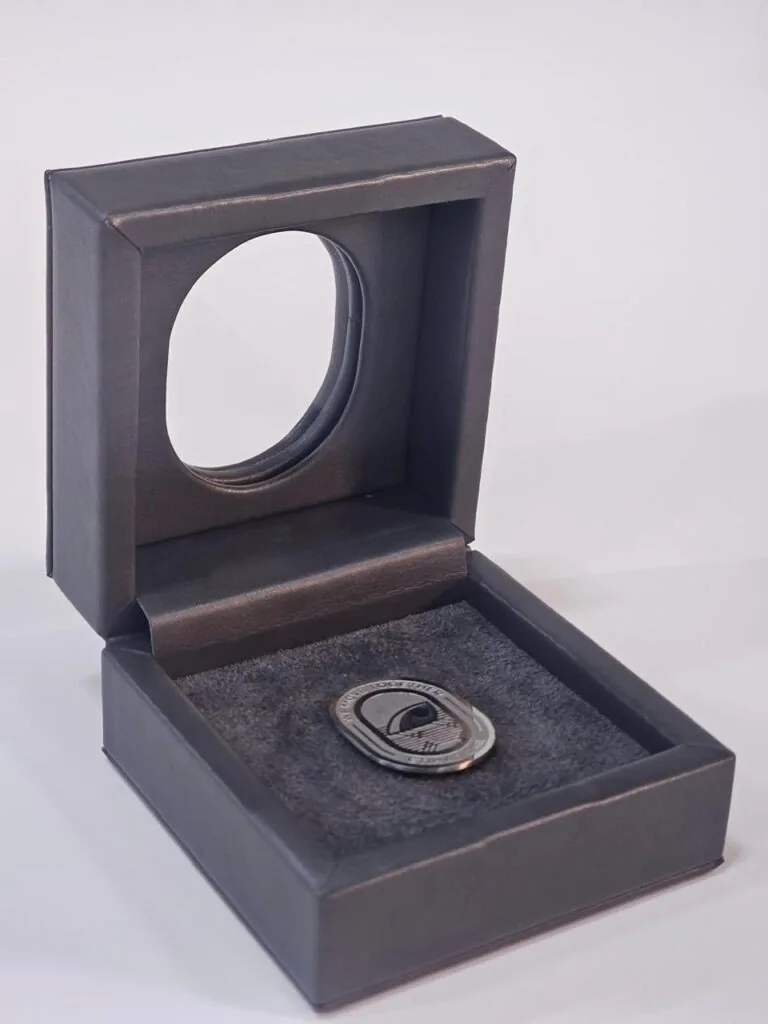

Most packaging concepts begin as artwork: a colour, a logo placement, a finish chosen from a sample book. Then the product arrives, the box has to hold it, and the concept gets rebuilt around the board. Designing for the board first is what stops that happening.

Greyboard shells wrapped in printed paper, shown beside a folding carton: board thickness is decided before any artwork is placed.
Start with what the box has to hold
Four answers come before any drawing: how heavy the product is, how large it is, whether the box will be opened more than once, and how it will be stacked or carried. Those four set the caliper, the wall construction and the closure. A glass jar and a set of paper samples can share artwork and share nothing else structurally.
Weight and size also decide the dieline. Internal dimensions come from the product and the insert that will hold it, while external dimensions follow from board thickness and wrap. Drawing the outside first and squeezing the product in afterwards is how a well-presented box arrives too tight to close, which is a problem nobody can fix once the run has been cut.
Let the material set the constraints
Boards behave differently under a crease. Greyboard takes a clean cut and holds a sharp corner; a lighter folding board flexes and wants its folds planned with the grain. A textured wrap hides a seam but shows every over-printed detail, and a smooth coated wrap is less forgiving of glue lines and fingerprints. None of that appears in artwork, and all of it shows up on the bench.
- Board caliper first, because it sets wall thickness, lid fit and how the box feels in the hand.
- Grain direction, so a crease folds cleanly instead of splitting the surface.
- Wrap paper, since coated, uncoated and textured stocks take ink and foil differently.
- Closure type: lid-and-base, magnetic and drawer each carry their own tolerances.
- Insert plan, drawn with the box rather than added once the artwork is approved.
Structure first, artwork second
With caliper, wrap and closure settled, the artwork has real boundaries to work inside. The logo lands where the wrap folds without cutting a corner, type keeps its distance from the edge where the seam will run, and each panel stays flat and stable enough to take a die. Nothing in the design has to fight the construction, and nothing gets shuffled the week before production.
Finishing sits in the same sequence. Foil stamping and emboss need a flat panel with board behind them, a deboss placed over a hinge or a magnet seat will not hold, and spot UV on a textured wrap scatters light instead of catching it. When the finish follows the structure, it lands where the board can actually support it.
What the sequence saves
Designing for the board is a habit rather than a stage, and it shows up in the quote. Over-specifying board to rescue a drawing is the expensive route, and it is where most revisions come from. Working the other way round gives a sample that matches the drawing, because the drawing was built around how the material behaves rather than how the artwork looked on a screen.
We approve samples before bulk production, so what you hold is what gets repeated across the run. Send the product, its weight and dimensions and how the box will be used, and we will come back with a caliper, a structure and two or three wrap options to draw against. The artwork can then be drawn once, on top of a decision that already works.
The Bottom Line
Confirm every choice on a physical sample before the run starts. Tell us what you are packing, how many you need and when you need it, and our team will come back with structure options, materials and pricing within a business day.