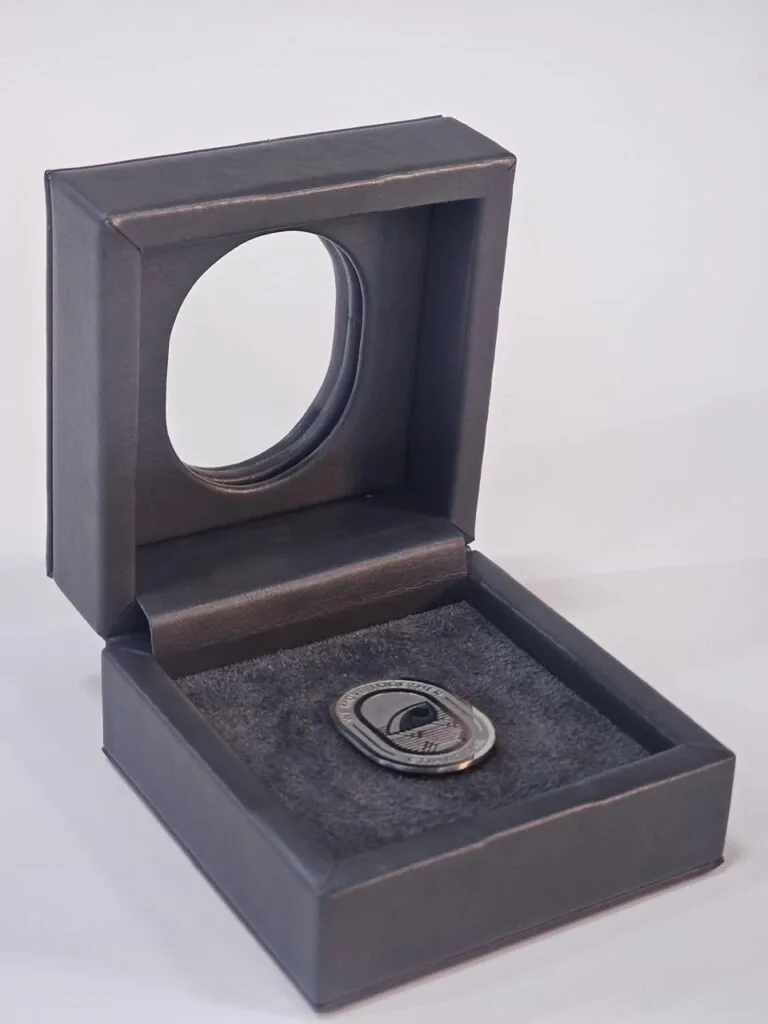

Leather reads as a premium covering because it holds a surface flat and turns a corner crisply. That is exactly what it stops doing when it is wrapped over folded board. Creases appear at the corner, faces bow outward, and the box looks soft long before it has been used. A rigid core is what prevents that.

A leather-covered rigid box with sharp corner returns and flat faces, built over a greyboard core rather than folded board.
Why folded construction fails under leather
A folding carton is built to move. Score lines are cut into the board so it can be creased quickly on a machine, and the covering follows that movement every time the box opens. Leather does not enjoy being bent back and forth along the same line: the surface stretches outside the fold, the grain opens, and after a few openings a pale line sits at the corner permanently. With a dark covering that line reads as wear before long.
The second problem is bowing. Thin board across a wide face has little resistance, so the covering pulls the faces slightly inward at rest and pushes them out once contents add weight. What should read as a flat, tailored surface ends up gently uneven, and light across the lid makes that obvious from across a room. Nothing has gone wrong in production; the structure simply was not asked to hold a plane.
What a rigid core does instead
Rigid construction starts with greyboard cut to size, so each face is a separate solid panel rather than one sheet waiting to be folded. The covering is applied over those panels and turned in at the edges. Nothing creases during use because there is no score line to move, and the faces stay flat because the board has the stiffness to hold them. The box behaves the same on the fortieth opening as it did on the first.
- Corners return sharply, since the covering turns over a cut edge instead of wrapping a hinge.
- Faces stay true, because a solid panel does not flex under the tension of the covering.
- The lid sits square, so the reveal reads even from every side of the box.
- Contents are carried by the structure rather than the covering, which is where folded builds weaken first.
Board thickness is set against the size of the box. Too light and a large face still moves; too heavy and the corner returns read bulky rather than tailored. Both ends of that range are easy to reject at sample stage and difficult to correct after a run, so we settle it with the actual covering material in hand.
Choosing the covering and the build together
Leather and leather-effect coverings differ in how far they stretch, so the material is tested on the real corner radius before the run. Natural hides vary from panel to panel, and a good sample shows where that variation will appear rather than hiding it. Edge paint, lining and the insert tray are decided at the same time, because thickness at the rim affects how the lid meets the base.
Lining is part of the same decision. A microfibre or suede-touch lining suits a box meant to be kept open on a desk, while a plain wrap keeps the interior quiet and lets the product do the talking. Either way, lining adds thickness at the rim, so the lid fit is checked after it goes in rather than before. Samples are made with the lining in place for that reason.
Approving the sample
We build a sample with the chosen material and core, then check corner returns, colour, hand feel and how the box behaves after repeated opening. Bulk production starts only after that sample has been approved, so the rigid build judged in hand is the one that arrives. A leather box is looked at closely by whoever receives it, so we inspect it just as closely first.
The Bottom Line
Confirm every choice on a physical sample before the run starts. Tell us what you are packing, how many you need and when you need it, and our team will come back with structure options, materials and pricing within a business day.