
Flat-sheet printing has one weakness nobody can design away: paper moves. It stretches in the press, it moves again through the folders, and by the time it is wrapped around greyboard the artwork no longer sits where the dieline said it would. Printing on the box itself keeps the image registered to the corners people actually look at.

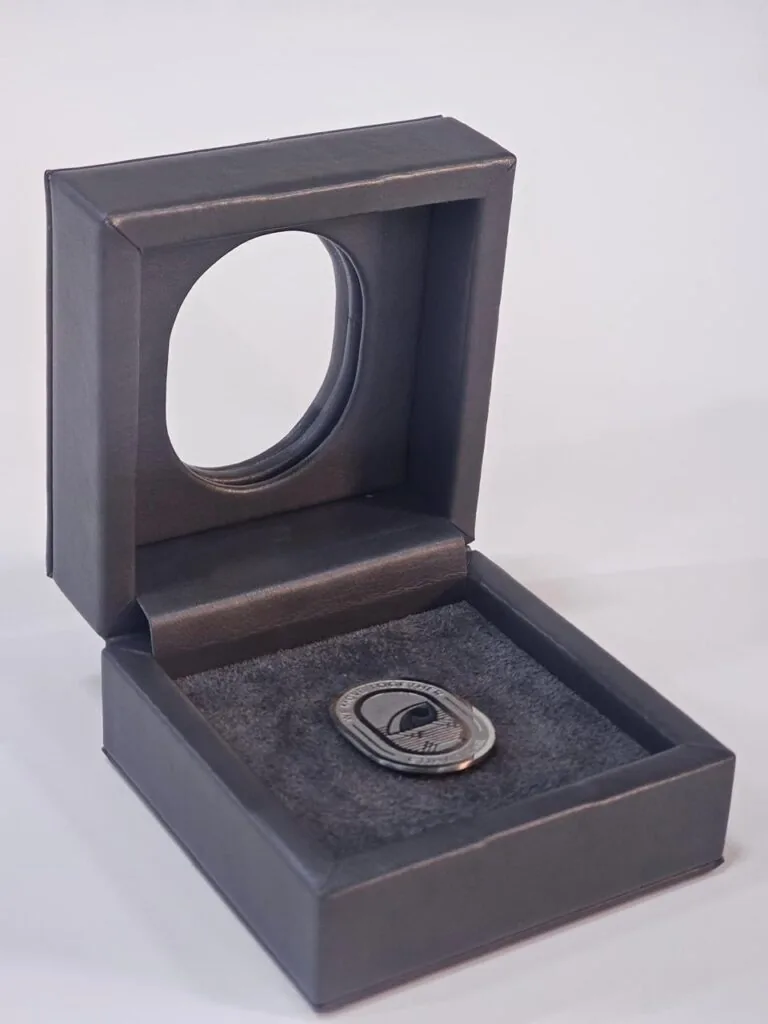
Rigid box panels printed after wrapping so the artwork stays aligned across the corners.
Why the sheet drifts
Paper is not a stable material. It takes on moisture, it grows and shrinks across the grain, and each pass through the press adds a little more movement. On a flat panel the error is small enough to ignore. Fold that same panel into a box and the error lands on the corner, where a straight line steps or a logo quietly loses its edge.
Wrapping adds a second layer of movement. The wrap is glued and pulled tight over the board, so any slack or stretch in the paper shows up as a shift between the artwork and the edge. Two panels printed together can end up looking different once the box is assembled, even though they left the press as a matched pair.
What printing on the box changes
When we print on the box, registration is measured against the finished object rather than against a flat sheet. The corner becomes the reference, so a pattern that runs across the lid and the base lines up where the eye checks it. Contrast between panels stays consistent, and small text keeps an even margin from the edge all the way round.
- Artwork positioned to the corner, not to a flat panel that moves when folded.
- Colour matched across the lid, base and sides after wrapping, not before.
- Foil and spot UV registered to the printed image on the finished surface.
- Seams and visible edges kept clear of the design where they would break it.
There are trade-offs, and we are straightforward about them. Printing on a wrapped surface needs a flatter, more forgiving substrate, and some finishes have to be sequenced differently. We check a sample first and agree the order of operations with you before anything runs on the full quantity.
Where it matters most
It matters where the design crosses a fold or a corner: continuous patterns, large fields of flat colour, anything built on a rule or a grid. It also matters on boxes that get handled closely, because a stepped line is one of the few flaws a non-designer spots straight away. Gifting and retail packs tend to be photographed, which raises the bar again.
On a plain two-colour box with generous margins, sheet printing may be perfectly fine, and we will say so when that is the case. The recommendation depends on the artwork, the board, the wrap and how the box is used, not on a preference for one press over another.
How we decide for your job
Send the artwork and a short note about how the box will be used, and we will look at where the design meets the folds. From there we propose the method, build a prototype and adjust the file from your comments. You see the corner behaviour in the hand before the full order is committed to anything.
That conversation takes less time than most buyers expect, and it prevents the expensive version of the same conversation later, when a whole wrapped run shows the same stepped line in the same place.
The Bottom Line
Confirm every choice on a physical sample before the run starts. Tell us what you are packing, how many you need and when you need it, and our team will come back with structure options, materials and pricing within a business day.