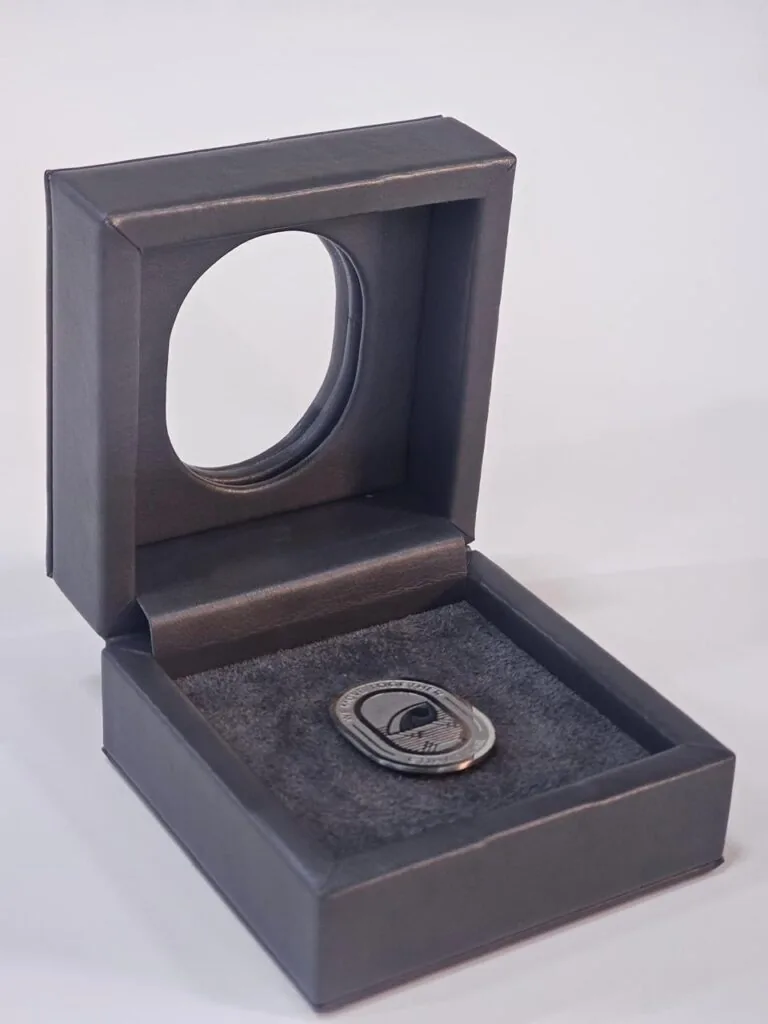

Foil on dark wrap and foil on a light wrap are two different jobs wearing the same colour. The metal sits on top of the printed surface, so everything underneath it changes how the mark reads. Black pulls the mark forward, ivory softens it, and a transparent foil lets the background decide the final colour either way.

A gold foil mark on a deep wrapper beside the same mark on ivory, where the background changes how the metal reads.
Why the background changes the foil
Most foils are at least partly transparent. On a light wrap a little of the paper shows through the film, so the same roll looks warmer on ivory than it does on white. On a deep wrap that transparency works in your favour: the dark ink underneath gives the metal depth, and the mark reads as richer without changing rolls.
The risk on a dark ground is different. Any slight misregistration shows as a pale halo where the die has pressed beyond the artwork, and a dense black that is not fully cured can move under the heat of the stamp. Opaque foils exist for this reason, and they behave consistently across both grounds when the artwork does not need the background to influence the colour.
What has to happen before the stamp
Foil on dark wrap is only as good as the printed surface underneath it. A flat, evenly cured ink film gives the die a stable platform; a heavy area of ink with soft dot gain gives it a moving one. On dark wraps ink density matters more than on light ones, because any weakness in the coverage reads straight through a transparent foil.
- Ink laydown checked on the actual wrap rather than on a coated proofing sheet.
- A Pantone reference for the ground colour, so the next batch matches the first.
- Lamination decided before foiling, since matt, soft-touch and gloss each change the sequence.
- Order of operations agreed: print, laminate, then foil, unless the finish says otherwise.
- Registration set with the die, because a halo on black is far more visible than on ivory.
Heat, pressure and dwell
Different wraps want different settings. A smooth coated paper takes a short, sharp impression and gives a crisp edge, while a textured or uncoated wrap needs more dwell to reach into the surface, which risks blurring the outline if the artwork is fine. Soft-touch lamination adds another variable: too much heat and the film marks, too little and the foil does not key properly.
This is also where scuffing is decided. Foil applied over a matt lamination is protected but slightly dulled; foil applied last stays bright but is exposed to handling during packing. Neither approach is wrong, but it should be chosen with the packing route in mind rather than corrected after the run has been cut.
Approving a metallic you cannot see on screen
A screen shows a colour; a sample shows a surface. Ask to see the chosen foil on both the dark and the light wrap before anything is approved, and look at them under the lighting the box will sit under. Turn the sample so the reflection moves, and check that the mark still holds its shape at the angle it will be read from.
That comparison is the whole subject in one object: same foil, two grounds, two results. We prepare samples before bulk production for exactly this reason, because a metallic that looked right in a file is still a guess until it has been stamped on the paper you actually chose.
The Bottom Line
Confirm every choice on a physical sample before the run starts. Tell us what you are packing, how many you need and when you need it, and our team will come back with structure options, materials and pricing within a business day.