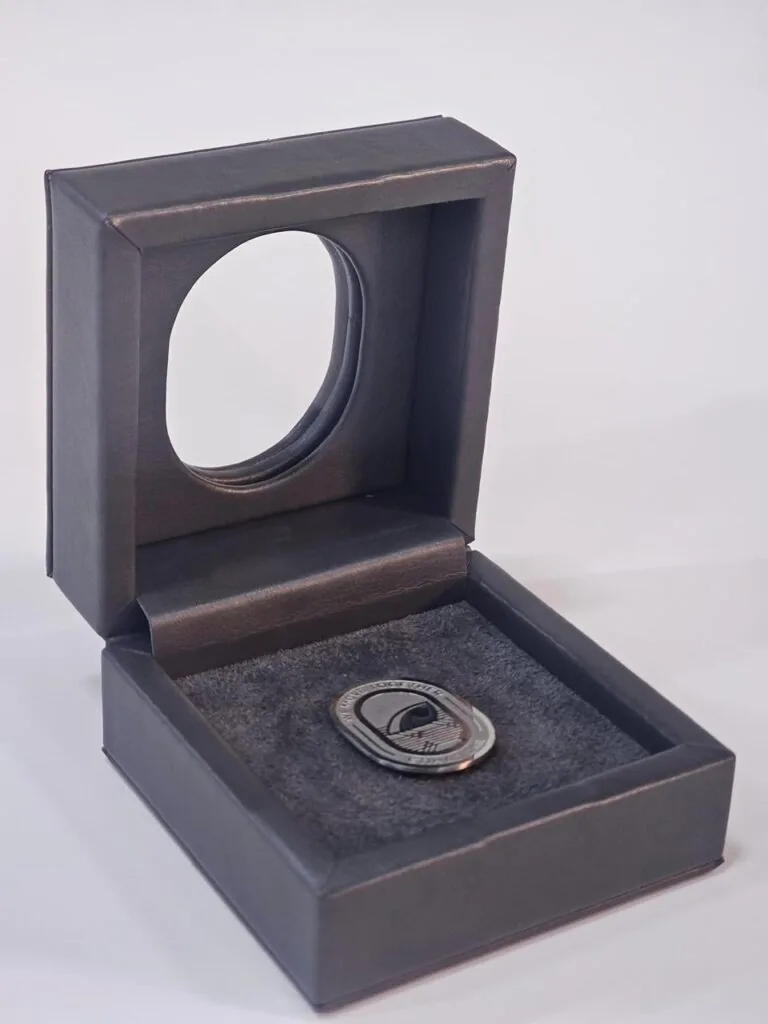

Veneer or solid wood is a choice between consistency and substance, and the right answer depends on the run size, the finish and how the box will be handled. Both look like timber, yet they behave very differently in production and in storage.
Wooden presentation box with a veneered lid and a solid timber base, showing grain and finish.
What each one is
Veneer is a thin slice of real timber bonded to an engineered core, then wrapped and finished like any other rigid panel. Solid wood is milled from a single piece, joined at the corners and finished on its own merits. The face of a veneered lid and the face of a solid lid can look identical in a photograph and feel quite different in the hand.
Neither is a compromise in disguise. Veneer gives real timber on the visible face with a stable core behind it, while solid wood gives a section you can see at the edge and a weight that reads straight away when the box is lifted.
Where each performs
Veneer suits most packaging runs. Because the face is sliced rather than sawn, the grain can be matched across a set, and the panel stays flat instead of moving with humidity the way a solid board does. It also takes print and finish more predictably, which matters when a logo has to land in the same place on every unit.
Solid wood earns its place where weight and edge detail carry the impression. A solid base with a visible joint tells the recipient something a wrapped edge cannot, and the box has a rigidity that does not depend on a core. The cost sits in the machining, the sanding and the finishing, all of which are done piece by piece.
For branding, both take a foil stamping hit or an emboss well, but the surface has to be prepared first. Sanded, sealed and checked before printing, a veneered face behaves like any other rigid panel, while solid stock needs the same preparation plus a decision about which way the grain runs under the mark.
Things that catch people out
- Grain varies naturally in solid stock, so two boxes from the same run will not be identical, while veneer can be sequence matched.
- Moisture moves solid wood, so a lid cut tight in a dry workshop can bind in a humid store and the clearance has to be generous.
- Finishes behave differently: an oil brings out grain and takes fingerprints, while a lacquer sits on the surface and scuffs more visibly.
- Weight affects freight and handling long before it affects perception, so the total packed weight is worth checking early.
Preparation is what makes the difference in practice. Both need a flat, sealed face before any print or foil goes on, and the joint lines on a solid lid have to be filled and sanded so a stamp does not catch. Ask to see a finished sample rather than a raw offcut, because the surface after finishing is what the recipient handles.
Deciding between them
The choice between veneer or solid wood usually follows the run size. If the run is large, the finish is printed or branded, and consistency across units matters, we point clients towards veneer. If the run is smaller, the box is meant to be kept as an object, and a visible edge or joint is part of the story, solid wood is usually worth the difference.
Either way we sample both, because veneer or solid wood is hard to judge from a written description. Holding a veneered lid next to a solid one settles the argument faster than a specification sheet, and the sample is approved before bulk production so the finish is agreed in daylight rather than on a screen.
Whichever route you take, write the decision into the specification rather than leaving it in an email thread. Naming the face material, the core, the finish and the grain direction means the next run starts from the same place as this one, even if the supplier or the mill changes.
The Bottom Line
Confirm every choice on a physical sample before the run starts. Tell us what you are packing, how many you need and when you need it, and our team will come back with structure options, materials and pricing within a business day.