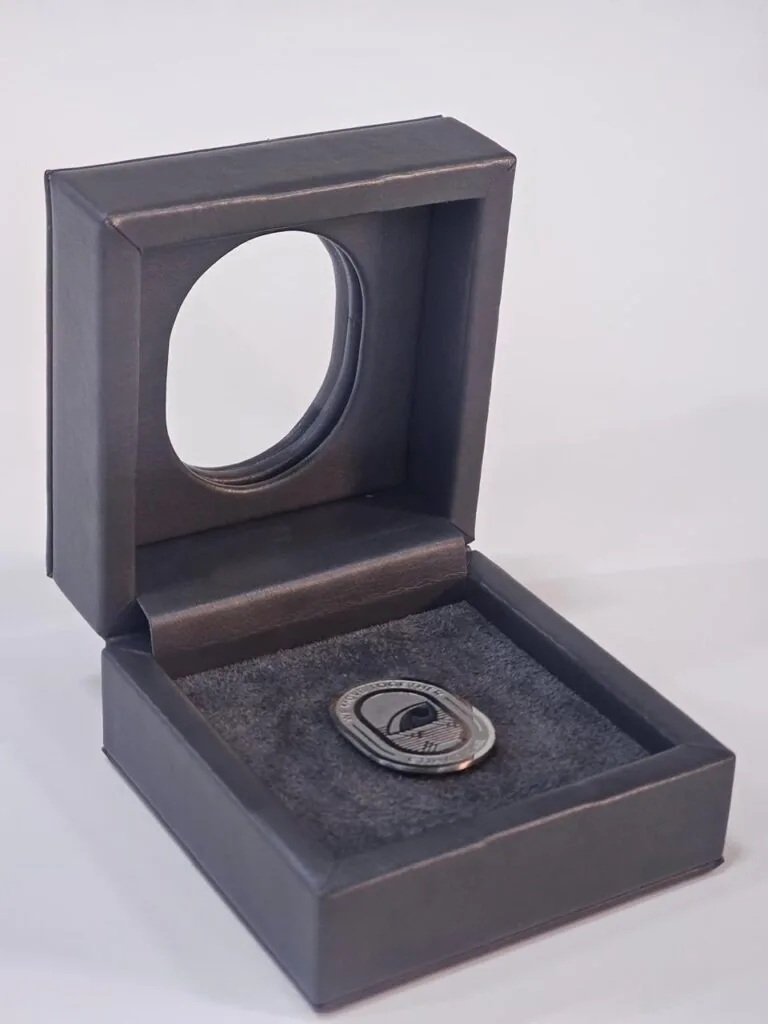

A ring box lives or dies on its insert, not on the outer board. Slot width, depth and the density of the foam decide whether a ring greets the buyer upright the moment the lid opens, or lies flat against the base where the stone catches nothing. We settle those measurements before any tooling is cut.
A rigid gift box opened to show a flocked insert tray, with die-cut slots cut to hold each ring upright at a slight angle.
What the insert has to do
The insert holds the ring, so it takes on three jobs at the same time. It grips the band so the piece does not rattle in transit or work loose against the lid. It presents the stone at an angle the buyer can see without lifting the ring out of the box. And it keeps the setting clear of the walls, so nothing knocks against it when the box is handled.
Those jobs pull against each other. A tight slot grips well but is slow to load on a packing line. A shallow slot shows the ring well but lets it twist when the box is carried. Resolving that tension is a matter of millimetres, and it starts with the thinnest band and the thickest band you plan to place in the same insert.
Measuring the slot
We begin with the bands themselves. Measure the narrowest ring you stock and the widest, then take the thickness of each band at its base, because a slim wedding band and a heavy signet do not sit the same way. The slot is cut slightly narrower than that thickness so the foam compresses and grips, but not so narrow that loading stresses the band or tears the flock on the way in.
- Slot width, set against band thickness with a small interference fit so the ring sits snug.
- Slot depth, deep enough to hold about two thirds of the band height while leaving the stone clear.
- Opening angle, a slight tilt toward the lid so the stone catches the light as the box opens.
- Edge finish, die-cut clean so no foam fibres catch on claws or prongs.
Depth matters as much as width. Too shallow and the ring topples when the box is carried across a showroom or tipped over in a drawer. Too deep and the stone drops below the rim of the slot, which defeats the purpose of showing it in the first place. We check both by dropping a ring into the sample slot and turning the box over, which is a blunt test but an honest one.
Material and colour under the ring
Most inserts are a foam core wrapped in flocked paper or velvet, chosen for the way the surface reads against metal. A dense, short pile gives a clean line around the band and keeps its shape after repeated loading. A longer pile looks softer but blurs the slot edges, and a row of rings can look untidy even when every piece is seated correctly.
Colour is worth specifying with the same care. Dark flock flatters most metals and hides the marks picked up during packing. Lighter tones suit rose gold and pearls but show every fingerprint, which makes gloves part of the packing routine. Whatever colour you choose, we ask to see the insert with real rings in it under the lighting you use, because a swatch of flock on its own tells you very little.
Approving the insert before the run
Once the measurements are agreed we cut a sample insert and place the actual rings in it. Grip, depth, angle and presentation are checked in hand, then adjusted if a ring sits low or leans too far. Bulk production starts only after that sample has been approved with the pieces it will hold. An insert that looks right on a drawing can still be wrong in the hand, and a sample is the shortest way to find out before a full run is committed.
The Bottom Line
Confirm every choice on a physical sample before the run starts. Tell us what you are packing, how many you need and when you need it, and our team will come back with structure options, materials and pricing within a business day.