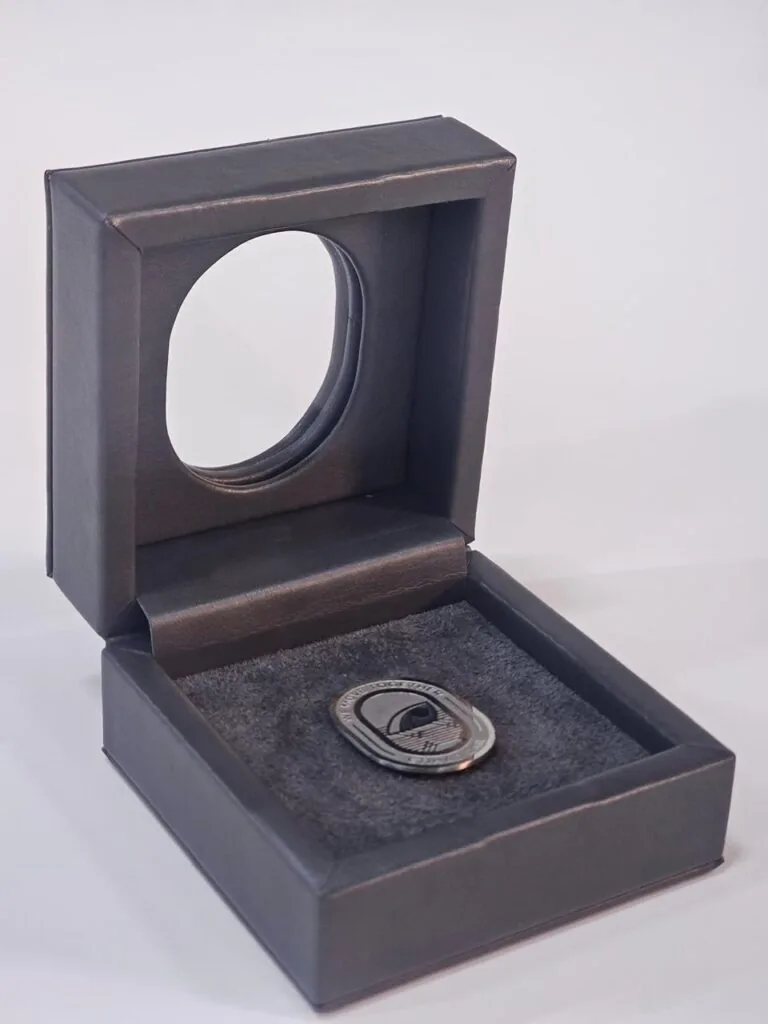

When buyers share a 3D render, it shows how a box might look, but it rarely shows how it will be made. We need a precise dieline to bridge the gap between design and making. A render can hide a tight corner that will crack on the wrap, or an insert that looks centred but will not clear the wrapped walls. The dieline makes those limits visible before we cut steel for the die.

A production dieline marked for die-cut, score and glue flaps on a rigid box blank.
What a dieline actually shows
A working dieline is a flat drawing that marks every cut, score, perforation and glue flap. For a rigid box, it must also account for greyboard thickness and the added bulk of the wrap, foil stamping or soft-touch lamination. Without those allowances, the lid-and-base will not close cleanly or the drawer box will bind. We check the scoring lines against the chosen GSM: too shallow and the fold springs back, too deep and the board splits along the score. These are mechanical details that no render can resolve accurately.
We also look at bleed, quiet zones and registration marks. If a colour bleeds to the edge, we need enough margin for the die-cut, not the image crop. For spot UV or deboss details, the dieline tells us where to hold clearance from folds. When we plan for ventilation or a specific closure, the drawing shows the exact space available. In short, the dieline is the contract for making, and the render is the mood board for approval.
Where renders mislead
Renders flatten perspective and often ignore real-world stretch. A wrap over a deep wall looks smooth in a model, but paper pulls tight at the corner. If the dieline does not adjust for that pull, we get a pleat or a thin white line at the apex. Similarly, an insert tray shown floating may press against the lid when the walls are wrapped. These issues are easy to fix on screen, but costly to fix after the die is cut. We test against the dieline first, then against a physical blank.
Colour is another common trap. Flat swatches do not show dot gain on uncoated stock, and lamination shifts tone under different light. A render can display Pantone with perfect saturation, but the real board will absorb more ink. By approving a dieline and then a wrapped corner, we avoid that gap. It takes a few extra minutes at this stage, but it saves rework later in the run.
Translating design into a build
To keep the build stable, we match the dieline to the chosen structure. A magnetic closure needs space behind the wrap without bulging the side walls. A book-style hinge needs a straight, uninterrupted score to last through repeated openings. For a ring box insert, the slot positions are measured from the inner walls after wrap allowance, not from the outer edge of the render. We can also adjust for flock or velvet, which add thickness more than a plain paper wrap. Each adjustment lives in the dieline, not in the image.
We always ask for a signed dieline before quoting a die. If a design is still fluid, we can suggest minor edits to the dieline that protect the look while keeping the structure sound. Samples are approved before bulk production, and that approval is against the dieline and a physical sample, not just the render.
- Fix allowances for board thickness and wrap before cutting the die.
- Confirm corner stretch for deep walls and tight radii on a blank.
- Approve colour on a wrapped sample, not only on a flat proof.
This keeps future orders consistent and prevents drift between batches.
A practical rule for buyers
Treat the render as a reference, but treat the dieline as a ruler. If the two disagree, the dieline wins. We would rather correct a line on the drawing than remake blanks. That discipline is how we keep tight fits, clean corners and the intended colour without unnecessary waste.
The Bottom Line
Confirm every choice on a physical sample before the run starts. Tell us what you are packing, how many you need and when you need it, and our team will come back with structure options, materials and pricing within a business day.